HCC v28 · RADV
Your risk score counts what was coded. Your clinicians documented more.
The conditions nobody entered are still in your consult letters and faxes. Verto reads them and shows the sentence behind each finding.
Scoped to a sample of your own records.

In use at
Regional medical centers and risk-bearing groups.


Why now
The model changed, and the auditor still asks for the note
Your clinicians do not have to document differently.
The CMS-HCC model moved to version 28. Conditions map to payment differently than they did under version 24, so a diagnosis that carried a score last year doesn't necessarily carry one now. Recapture has to be established again, member by member, and somebody has to read the documentation to do it.
In Verto's own risk work, 19% of members had a qualifying HCC v28 condition that coded data alone had missed. The condition was in the record, but not in the data the score was calculated from.
Counted by condition instead of by member, reading the full record captured 22% more risk factors.
A RADV review doesn't ask what you submitted. It asks you to produce the record behind it, and a diagnosis you can't show in the chart is a diagnosis you give back with the payment attached to it.
If your coding misses conditions, you aren't paid for the care you provide. If it claims more than the chart supports, you pay it back later.
In a two-sided contract you meet both of those at reconciliation, after the year is closed and nothing can be done about it.
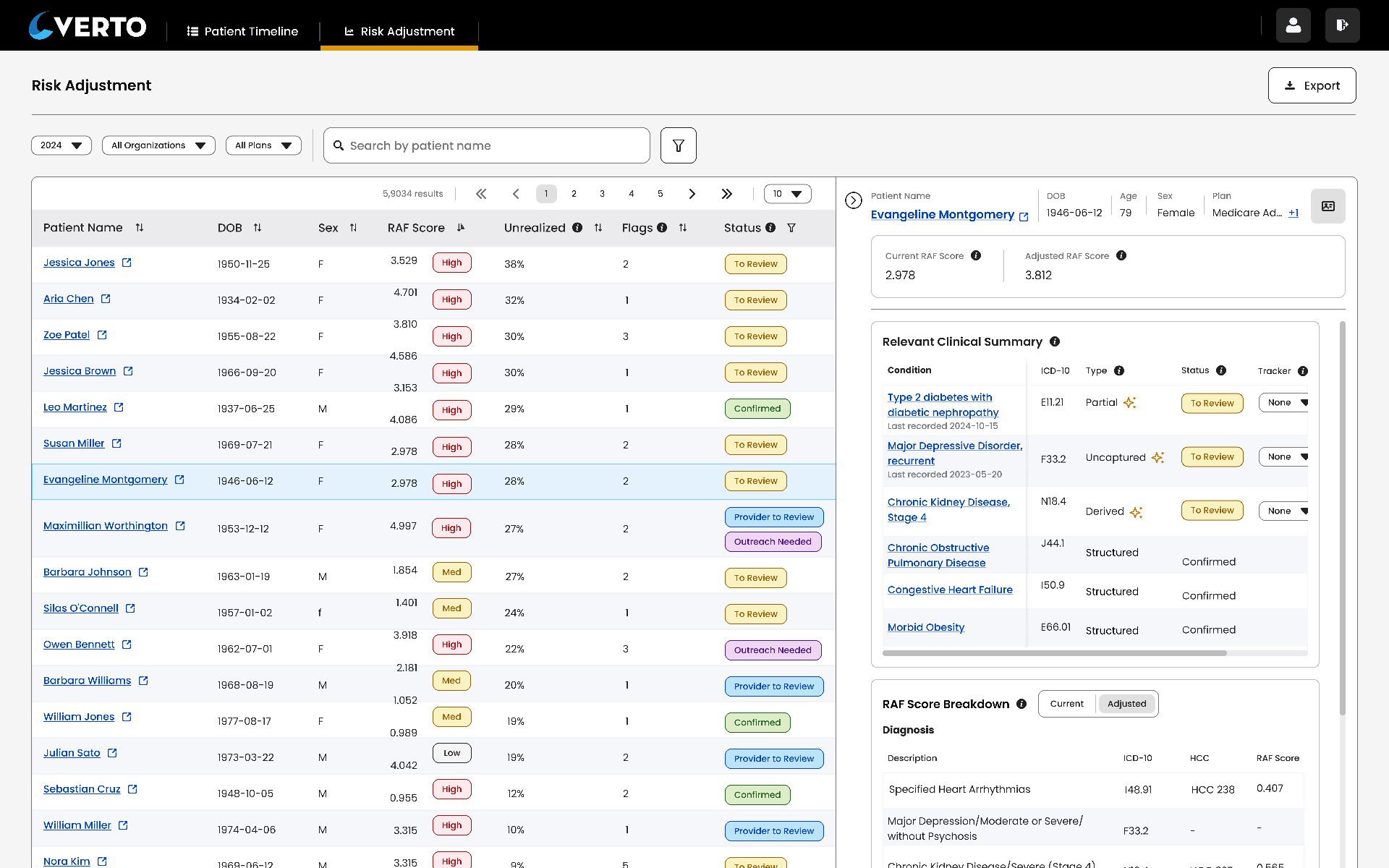
Work every chart,not a sample of them.
- 01
Pull the record together from every system you run.
Each EHR, claims, health information exchange feeds, and the material that arrives as faxes and scanned PDFs. One view per member, with every fact still tied to the document it came from. - 02
Rank members by the size of the difference.
Compare what the record documents against what was ever coded, member by member. Your reviewers start at the top of a list instead of sampling their way through a panel. - 03
Send each finding to the person who can act on it.
Documentation queries go to the clinician who can answer them, confirmed conditions go to coding with the supporting text attached. A condition nobody coded is often a condition nobody is managing, so the same list is a care list.
Every finding opens onto the sentence it came from
When an auditor asks where a finding came from, you put the note in front of them. Every finding Verto reports carries a link to the text that produced it, so a reviewer opens the finding, reads the sentence a clinician actually wrote, and accepts it or rejects it.
Verto calls this provenance.
Overall Winner
named overall winner of the 2025 AI Challenge run by HL7 International, the health data standards body, for Verto's entry on reading unstructured records
HL7 International, announced 17 September 2025 at the 39th Annual Plenary
Reported
Chronic systolic heart failure, documented and never coded
Candidate HCC · absent from the coded feed
Admitted with progressive shortness of breath and volume overload. Echocardiogram today shows an ejection fraction of 32%, down from 45% in March. Impression: chronic systolic congestive heart failure, stable at discharge on guideline-directed medical therapy and a lower diuretic dose.
Sample record.
Verto's own figures
What the gap between coded and documented conditions is worth
Measured in Verto's own risk-adjustment work.
Verto figure
$4,300+
in risk-adjusted revenue recovered per member

22%
more risk factors captured once unstructured records are read alongside coded data
$10,000 to $11,000
is what a single point of RAF is worth per member, per year, in US risk-bearing contracts
10+ hours
a week returned to clinical staff from chart review
An informaticist and registered nurse at a rural medical center in the United States
20 minutes to 2 seconds
Risk adjustment evidence and coding review
- 01How does clinical record review support risk adjustment?
- Verto reads clinical records to surface potentially relevant conditions with supporting text. Coding teams review that evidence against the applicable requirements before deciding what can be reported.
- 02Can AI-generated findings be submitted as diagnosis codes automatically?
- A surfaced finding is not a coding determination. The accountable reviewer must evaluate the source documentation, applicable period and coding rules. Source visibility supports that review; audit acceptance depends on the documentation and applicable requirements.
- 03What should a risk adjustment validation sample include?
- Include representative document types, ambiguous cases and records without positive findings. Compare results with a qualified reference review and examine false positives, missed conditions and reviewer effort.
- 04How do we distinguish documentation recovery from financial impact?
- Record supported findings and reviewer decisions first. Any estimate of payment impact needs the applicable model, population and reporting context; additional findings alone do not establish a reimbursement result.
Next step
Measure the gap on your own members
Send a sample of your records. You get back a count of the conditions your coded data missed, each one linked to the text that supports it, so your coders can check the work before anything is submitted.