Your nurses are answering calls your booking page could have taken.
The callers who need a nurse wait behind the ones who only wanted a booking. Verto sorts your calls before the queue, so your nurses reach the callers who need them first.

Capacity is set a year ahead, and demand isn't.
A health line's capacity is fixed by its budget and by how many nurses it can hire. Demand follows whatever happened that week. When the two don't match, the queue absorbs the difference, and the wait appears on a public dashboard.
Much of what is waiting in that queue isn't a nursing question. Somebody needs to know which clinic is open tonight, where to renew a prescription, or how to get an appointment they could have booked themselves.
A caller who needs a nurse waits behind every one of those calls.
How Verto is used on a health line
Sort the demand before it reaches the queue
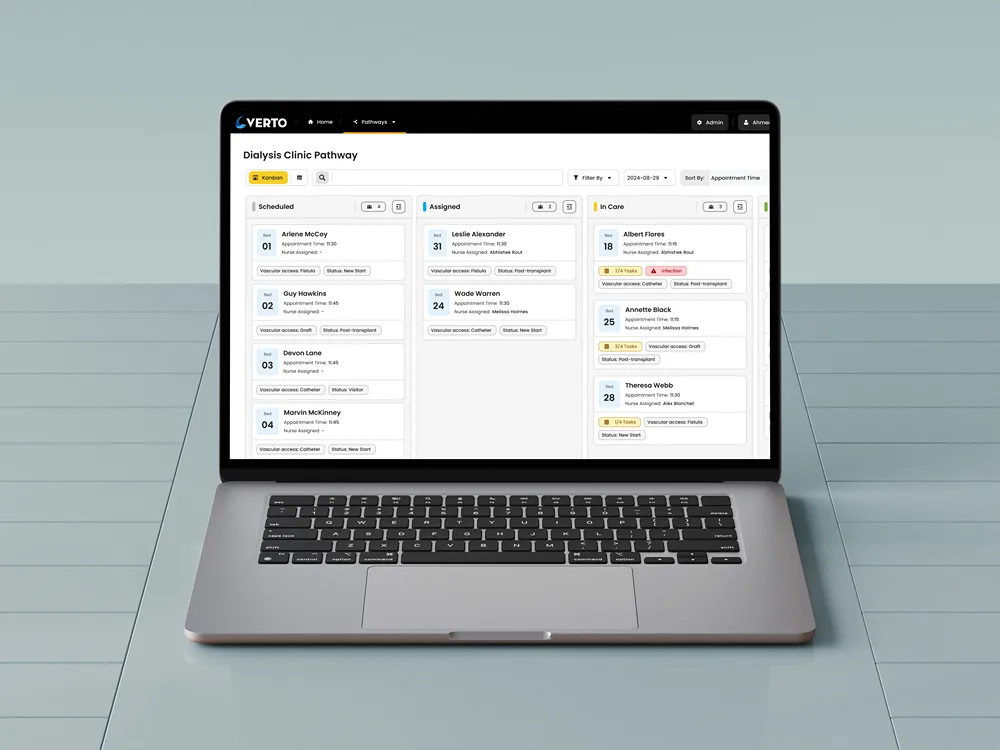
Verto fits into the health line workflow you already run. It answers what it can before a call reaches the queue, and sorts the rest by priority.
- 01
Answer questions up front
Callers get answers to common questions, like which clinic is open, how to renew a prescription or how to book, before they ever wait for a nurse. - 02
Stratify by risk
Your queue is sorted by priority, so the callers who need a nurse most are reached first. A symptom that needs assessment now doesn't wait behind a question about clinic hours. - 03
Offer virtual options
Some callers don't need to stay on the line at all. Verto can move them to a virtual visit, a booked appointment or the right service, and send anyone who needs a person straight to your team.
Ontario Breast Screening Program (OBSP) clients chose Verto because it was the only vendor that could run complex appointment triage and qualification.
Is it really that hard to see the full picture?
Yes. Three systems hold the answer between them, and none of them talks to the others when the phone rings. Verto reads all three, so it knows who is calling before the call is sorted.
The phone line
It has the number that is calling.
The booking system
It has whatever this caller already has on the books.
The EMR
It has who this patient is, and what is open on their chart.
Every callergets an answer.
Somebody who wants a person speaks to a person.
A lookup or a booking that finishes on its own never joins the queue, so the queue is shorter for the callers who need a nurse.
Voice
Everything works by phone, for callers who won't use a browser and those who can't.
Text message
A link, a confirmation or a reminder reaches a basic handset with no data plan behind it.
Preferences
Each call follows the caller's preferences, from how they want to be reached to the language they speak.
A person
A person is one step away on every path.
What changes when the queue is sorted.
53%
fewer missed appointments once booking and reminders ran through Verto, at a breast-screening program
70%
less administrative time spent on triage and booking, at a breast-screening program
120+
clinic deployments run on Verto
811 workflows and patient navigation
- 01How can an 811 service separate booking requests from clinical triage?
- Identify which callers need administrative help and which need clinical assessment. Verto supports patient access and booking workflows. Your service keeps responsibility for triage rules and clinical escalation.
- 02Does call center automation replace nurse assessment?
- No. Administrative automation and clinical assessment serve different purposes. Define which tasks can be routed or booked and which must reach a qualified professional, including uncertain or urgent situations.
- 03What should health-line teams test before automating patient navigation?
- Test service eligibility, availability, failed bookings, handoffs and the route back to a person. Include callers with language, accessibility and digital access needs in workflow evaluation.
- 04How do I measure the success of a health line?
- Measure completed administrative tasks, successful clinical handoffs, repeat contacts and unresolved requests. Review time saved alongside access and safety outcomes rather than targeting shorter calls alone.
Next step
Find out which of your calls never needed the queue.
A first conversation about your line, not a demo.
No account, no call.