The care your patients need is already in your records.

Verto is a population health platform. Connect finds the signals already sitting in your charts, Flow tracks the referral nobody is watching, and Engage gets the patient through the door.

Sample record · Unattached patients

Emergency department triage note·22 May 2026 · free text
…patient states theyhaven't had a family doctor since moving from Sudbury in 2023and has been using the ED for prescription renewals.

Verto found

Unattached, three emergency visits this year

No family physician on file · ranked by need

Verto did

  • Added to the attachment roster
  • Booking offer sent by text
  • Roster updates the day she is attached
In your chart

Roster and booking written to her chart. Nobody logged into a second system.
The delays

Where the time goes

Verto's founder says delays are the main reason healthcare is expensive. Verto's own worked example puts the cost of delays at $152KVerto model for one patient with diabetes, over a lifetime.

Mis-screening

Connect: reads what is already in your records

Most of what you would act on is already in your own records, in a scanned fax, a progress note, a discharge summary. That material sits unread because none of it arrives as data a system can sort or search.

"Find the conditions that never became a code."
Patients with no family doctor, in your own records

Referral

Flow: watches the referral until someone finishes it

The referral was made and everyone knows it exists, and after that nobody is watching the clock. Nobody finds out, because a stalled referral looks exactly like one that is moving.

"The care gap isn't closed when it's found, it's closed when someone finishes the steps."
811 health-line demand, routed by level of care

Follow-up

Engage: gets the patient through the door

The clinic is running, the program has capacity, and the appointment is there to be booked. The patient never books it, because finding the route means knowing which service to ask for and which number to call.

"None of it matters if the patient can't get through the door."
One front door across every service

The five steps

Health data needs work before any tool can use it.

It arrives mixed together and unlabeled, from systems that don't talk to each other. Here's what it takes to make it usable.

What goes in

  • Scanned faxes
  • Free-text progress notes
  • Several medical records systems
  • Discharge summaries
  • Referral letters

The refining

  1. 1

    Ingest

    Take the source as it arrives.

  2. 2

    Normalize

    One patient across systems that disagree.

  3. 3

    Read the prose

    Find the conditions that never became a code.

  4. 4

    Code

    Attach the codes, and the programs the patient qualifies for.

  5. 5

    Provenance

    Bind each concept to the sentence it came from.

What comes out

  • A patient summary, readable in a minute
  • An interoperable record other systems consume
  • A risk score with its evidence attached
  • A cohort list, ranked
  • A care-gap worklist that routes to a person

Which tools need which kind of data

The tool you want to runThe grade it runs on
A helper chatbot that answers appointment questions
Appointment data and the unstructured notes
A digital front door that books the right service
Appointment data, and a service list that matches what you run
A screening or triage queue
Verified demographics, and a structured screening history
An unattached-patient registry
Records reconciled across systems, one identity per person
A quality measure or a risk score you report
Coded data reconciled against the chart, each finding tied to its sentence
A care-gap worklist that opens a task in the chart
The reconciled record, and a write path back into the chart
A diagnostic agent
A fully validated medical history

How ready your data is decides which of these you can use.

Drawn from the deployments Verto already runs.

Nobody runs a model on a record they cannot check,so every concept keeps the sentence it came from.

The three jobs

Read the record, rank it, then contact the patient.

All three do one thing: raise the longitudinal awareness around every patient, so each one gets more sustainable, better quality care at scale.

01

Connect

understand the population data

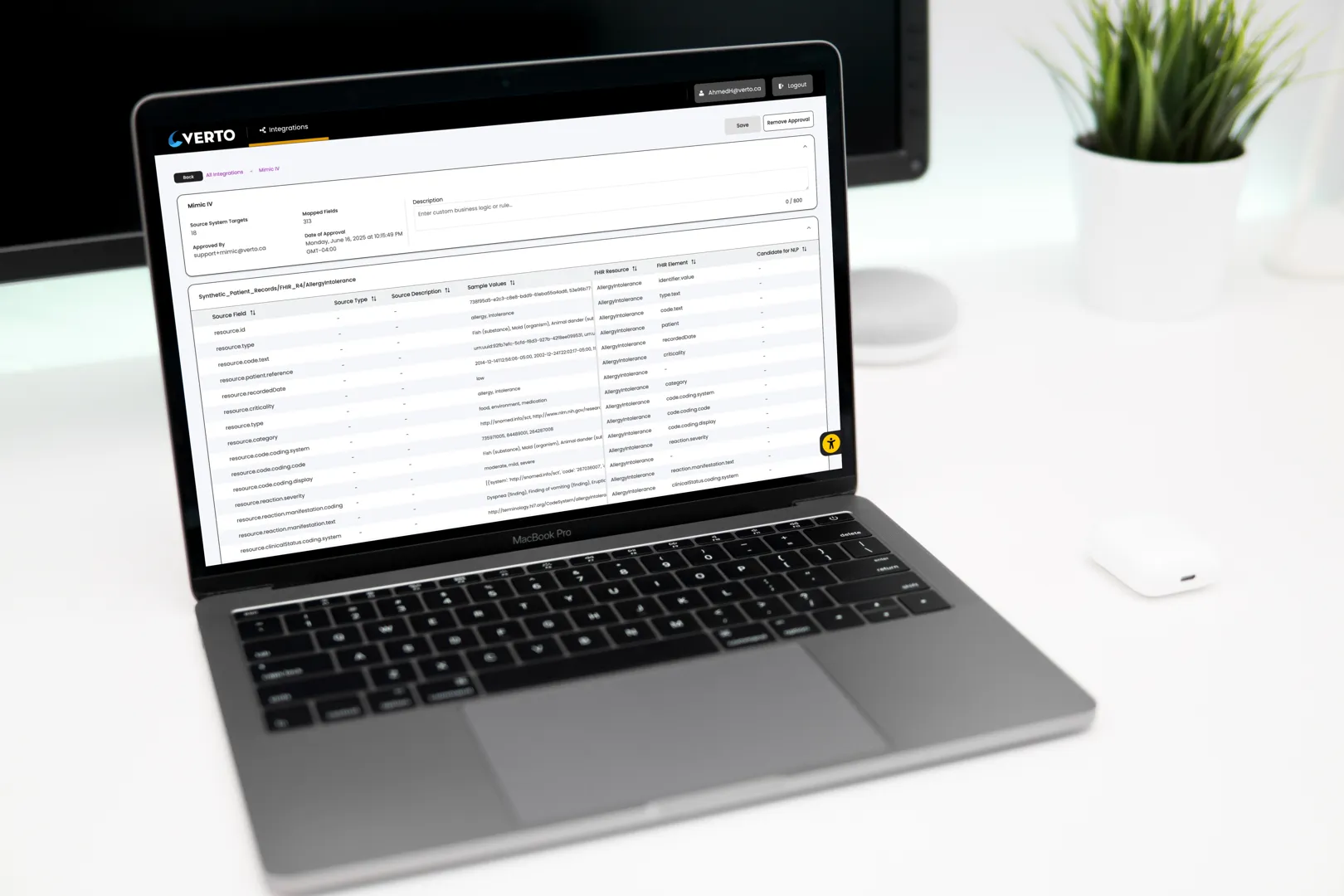
Connect reads every source you already use and combines them into one view per patient, including scanned faxes that no data standard covers. HL7, the health-data standards body, named it 2025 AI Challenge winner.

Connect on an unattached-patient registry
Verto Connect showing the sources it reads from, on a laptop
02

Flow

rank by risk and track every referral to the end

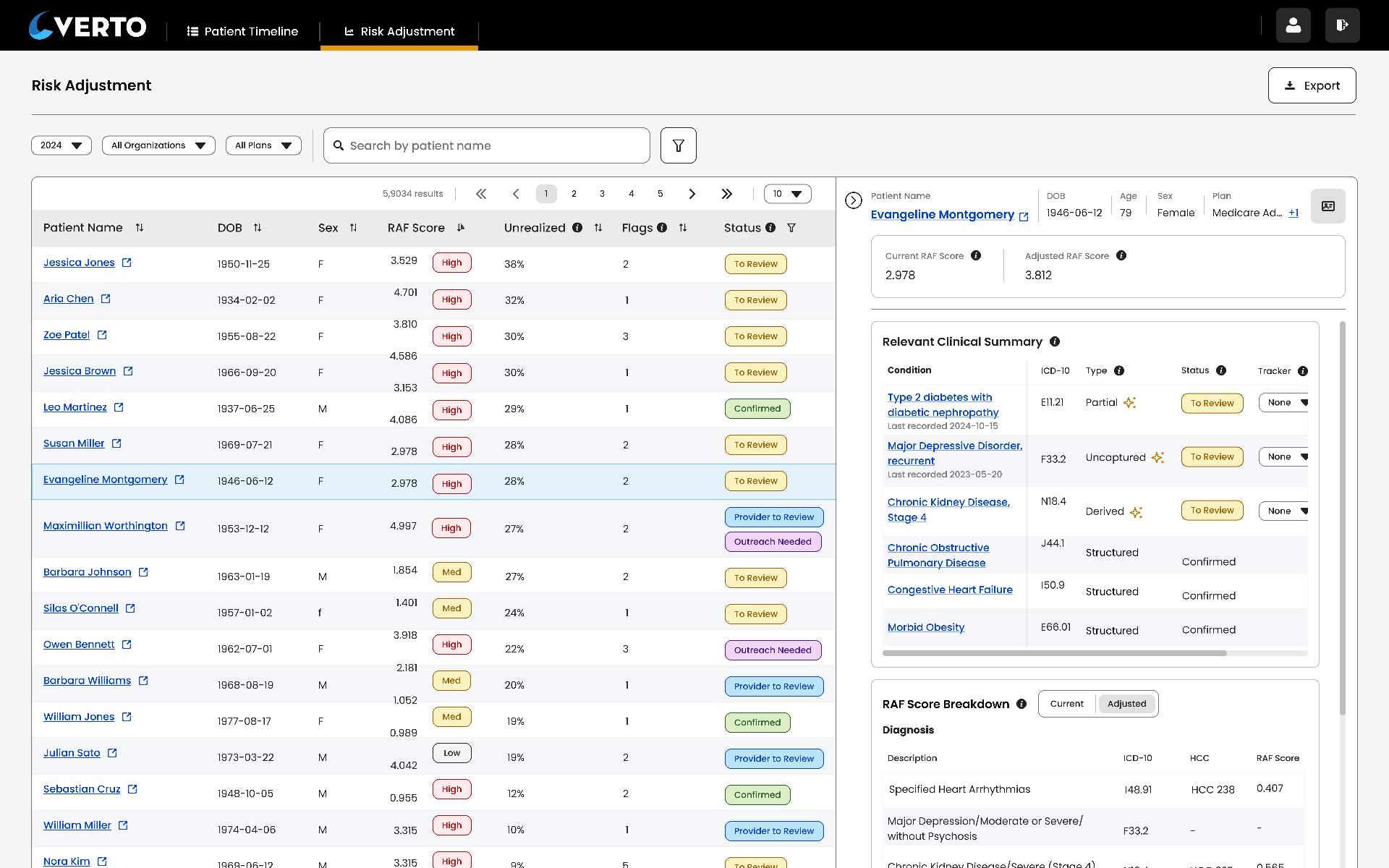
Once Connect has made the record readable, Flow ranks it, because a list of everything is the same as no list at all. It surfaces the conditions your coded data missed, and puts the people who need contact first at the top.

Flow on a provincial health line
A Verto dashboard ranking a population by need
03

Engage

close care gaps

Engage runs the outreach, the booking and the reminders, by text and by phone, the way each patient prefers. A worklist only counts once somebody is contacted.

Engage as a digital front door
Verto Engage running patient outreach on a laptop
Practical guideWhat happens after a referral is sent?Use a stage-by-stage workflow with ownership and completion evidence.

Where Verto sits

Verto reads from the systems you already run

How every finding links back to its source

What it reads, what it returns

Runs beside Accuro, Cerner, DACIMA and HL7 FHIR

Accuro, Cerner and DACIMA are record systems, and HL7 FHIR is the standard they exchange through. Your clinicians keep the one they already work in, because Verto reads from it instead of replacing it.

Returns findings into the tools your team already opens

A finding that lands in a separate dashboard is a finding nobody acts on, so Verto returns it to the person who can act, as a worklist in a tool they already open.

At what scale

How much has run on Verto

120+

clinic deployments run on Verto

Cloudflare case study

1M

unique visitors served in a single month across Verto-run patient services

Cloudflare, 2021

Fraser Health

67,000

people found care through Fraser Health's digital front door in its first year

Fraser Health, December 2024

Peer-reviewed
Published in a journal, with the citation attached.
Named source
A named organization published it: the customer, the award body, the auditor or the vendor, with the link attached.
Verto
Published by Verto.
Verto figure
Measured by Verto in its own live deployments.

Next step

Run a record through our summary tool.


No account, no call.

See what care gaps we can close

A first conversation about your patients, not a demo.