Your patients can't find the services you already run.
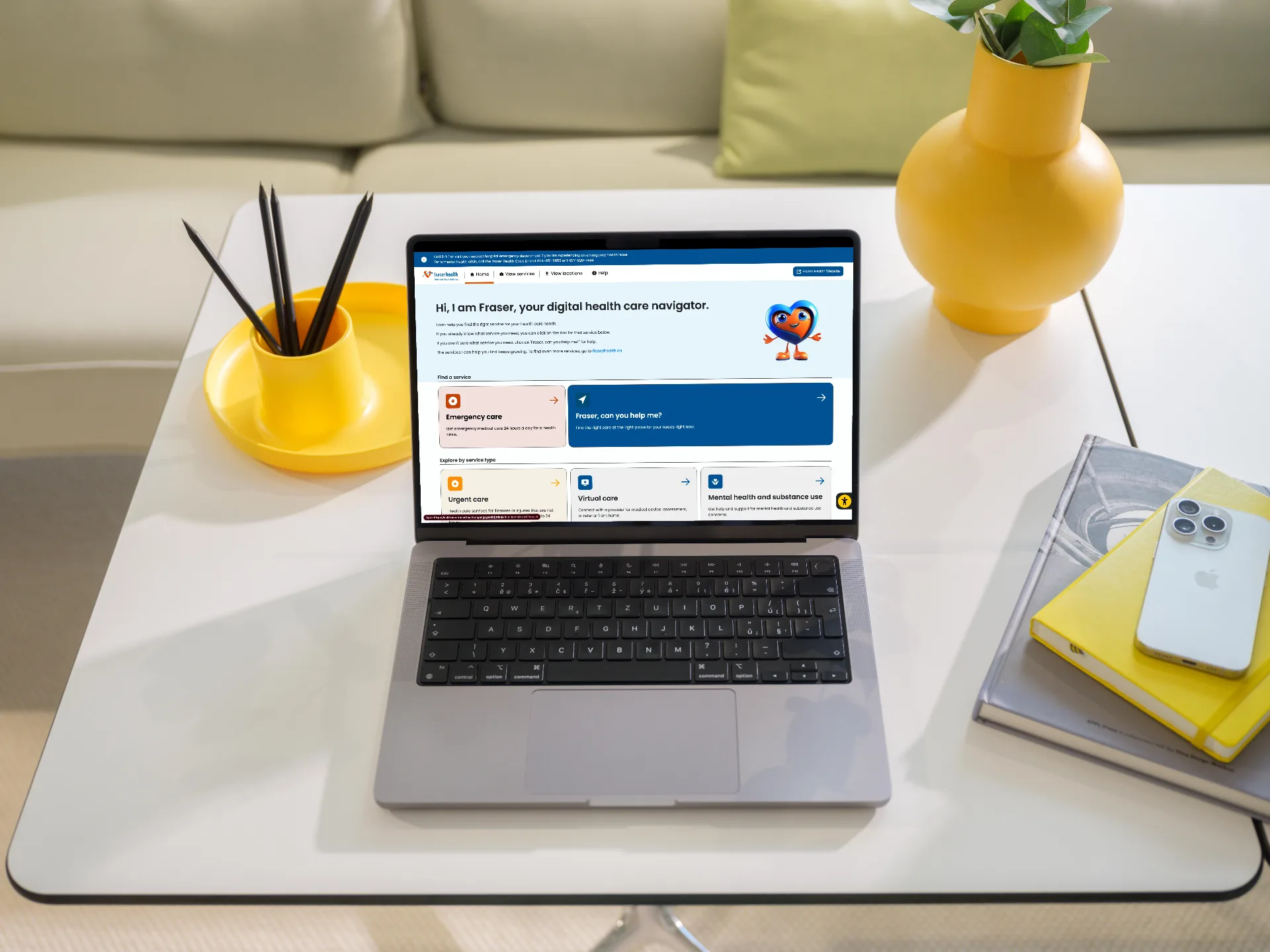
A patient with a symptom and a phone acts on whatever they find in that minute. Fraser Health and Youth Wellness Hubs Ontario use Verto to give them one place to look.

- 67,000
- people found care through Fraser Health's digital front door in its first yearFraser Health, December 2024
- 87%
- of patients were satisfied with virtual urgent care at CAMHGratzer D, et al. Healthcare Quarterly 28(3):35-41, October 2025. DOI 10.12927/hcq.2025.27733
Each service was funded separately,and a patient has to know which one to call.
A health authority runs urgent care, virtual visits, mental health intake, screening programs, clinics and specialty referral. Each got its own funding and its own announcement.
Patients just need care. So they call a number they already know, or they go to the emergency department.
People end up in the wrong place. Clinics with open appointments sit empty while the emergency department fills up.
Do I have to leave my EMR to use the Verto platform?
No. A portal on your electronic medical record (EMR) is one vendor's window onto one vendor's system. It can offer only what that system holds.
Your patients need services that sit across several systems and several organizations, including ones your record vendor can't see. Verto reads those systems over HL7 and FHIR, and what comes back lands inside the record your team already opens.
Fraser Health's front door runs alongside its EMR.
How a request gets sorted, booked and followed up
- 01
Gather what you already have, faxes included
Bring together the records your organization already has but can't see, including faxes and scanned documents. Connect, Verto's engine, reads all of it. - 02
Stratify by risk
Sort each request to self-care, a virtual visit, a booked appointment, or assessment now. - 03
Close care gaps
A care gap stays open until the patient has finished the steps. Follow up on the web for the people who use it, and by text and voice for the people who don't, in the languages your population speaks.
A national clinic group chose Verto because it was the only one that would run the assessment workflow they had built, inside the door.
31% would have gone to an emergency department instead.
31%
of patients using virtual mental health services run on Verto said they would otherwise have gone to an emergency department
Gratzer D, et al. Healthcare Quarterly 28(3):35-41, October 2025. DOI 10.12927/hcq.2025.27733
1M
unique visitors served in a single month across Verto-run patient services
Text, voice and the language the patient speaks
The hardest patient to reach has a basic phone, no browser, and doesn't read English.
They can still find the right service and book it, by text message or automated phone call, in their preferred language.
Digital front doors and patient access
- 01What is a digital front door?
- A digital front door gives patients a place to find and access services. Verto supports service navigation, triage and booking workflows connected to the systems the organization already runs.
- 02How does a digital front door differ from a patient portal?
- A portal usually gives access to records or an existing provider relationship. A digital front door focuses on finding the appropriate service and reaching it. Define whether your program needs discovery, triage, booking or all three.
- 03Can patient booking connect to an existing clinical workflow?
- Yes. Verto supports workflows built around existing clinical systems. Many of our clients use Verto for virtual care without leaving their EMR. The scope of each new deployment depends on the booking systems and service rules available.
- 04How do I measure the success of a digital front door?
- Track successful navigation, completed bookings and access to the intended service, alongside abandonment and support needs. Website visits alone don't show whether people received care.
Next step
Find out what care gaps we can close for you.
A first conversation about your patients, not a demo.
No account, no call.