You open a finding, and you read the sentence a clinician wrote.
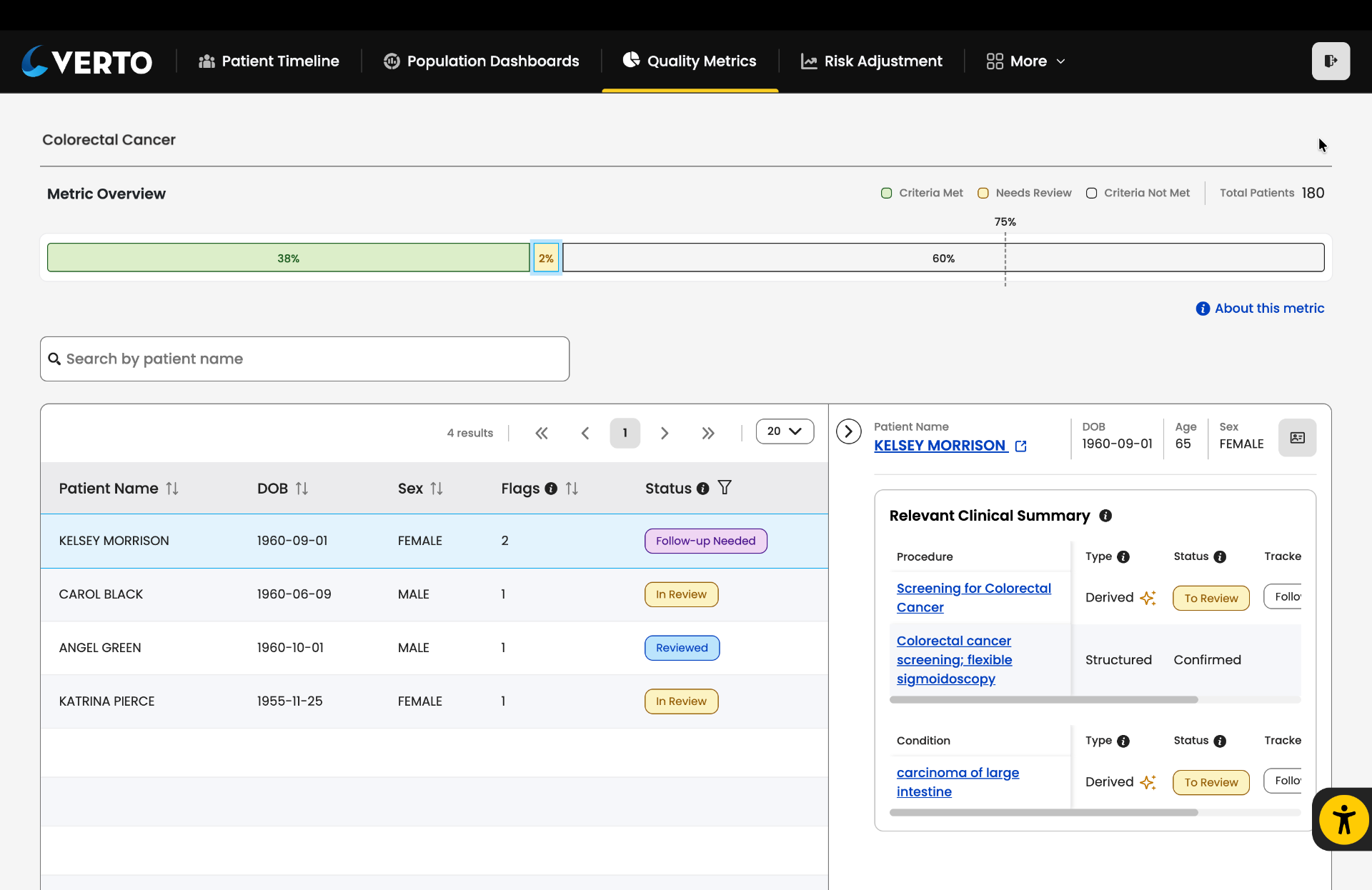
Verto reports nothing it can't trace. Every finding opens with the document it came from, its date, the coding, and the sentence a clinician wrote.
No account, no call.
- Overall Winner
- named overall winner of the 2025 AI Challenge run by HL7 International, the health data standards body, for Verto's entry on reading unstructured recordsHL7 International, announced 17 September 2025 at the 39th Annual Plenary
- SOC 2 Type II
- audited, and the report goes to your security reviewer under a non-disclosure agreement
What a reviewer sees
This is what a reviewer seeswhen they open a finding.
Reported
Severe protein-calorie malnutrition
ICD-10-CM E43 · documented, never coded
Intake below half of estimated requirements for three weeks, 11 kg lost since September. Assessment: severe protein-calorie malnutrition, with temporal wasting and loss of subcutaneous fat on examination. Started on oral supplements, dietitian to review weekly.
An example record, not a real patient.
Four things arrive with every finding: the document, its date, the coding, and the sentence with the phrase that justified it marked in place.
A reviewer who doesn't trust the engine can still check the finding, because the sentence is one a clinician wrote before any model read it.
From the fax arriving to the reviewer clicking the finding
- 01
The document stays as it arrived
The original is the evidence, so no tidied version replaces it. A fax stays a fax. - 02
The engine reads the text off it
A scan becomes readable text. The engine records which document each sentence came from, the date on that document, and where in it the sentence falls. - 03
The engine reads the notes for conditions a clinician described but never coded
Reading prose is the part a coded feed cannot do. A clinician can describe a condition in a sentence and never enter it in a field. It is still a condition they documented.
- 04
The concept keeps its coding and its sentence
The engine stores the code and the sentence together, so a finding cannot later be shown without its source text. - 05
The engine drops what it cannot tie to a sentence
What happens when there is no sentence
Where there is no sentence, the engine reports nothing, so the reviewer never sees it.
Two ways to trust a finding
- Explainability
- An explanation of how a model reached its conclusion. The explanation is produced by the same system that produced the conclusion, so checking it means trusting it.
- Provenance
- The text a clinician wrote, in the document they wrote it in. It existed before any model read it, and it is evidence whichever way the review goes.
A reviewer makes the call
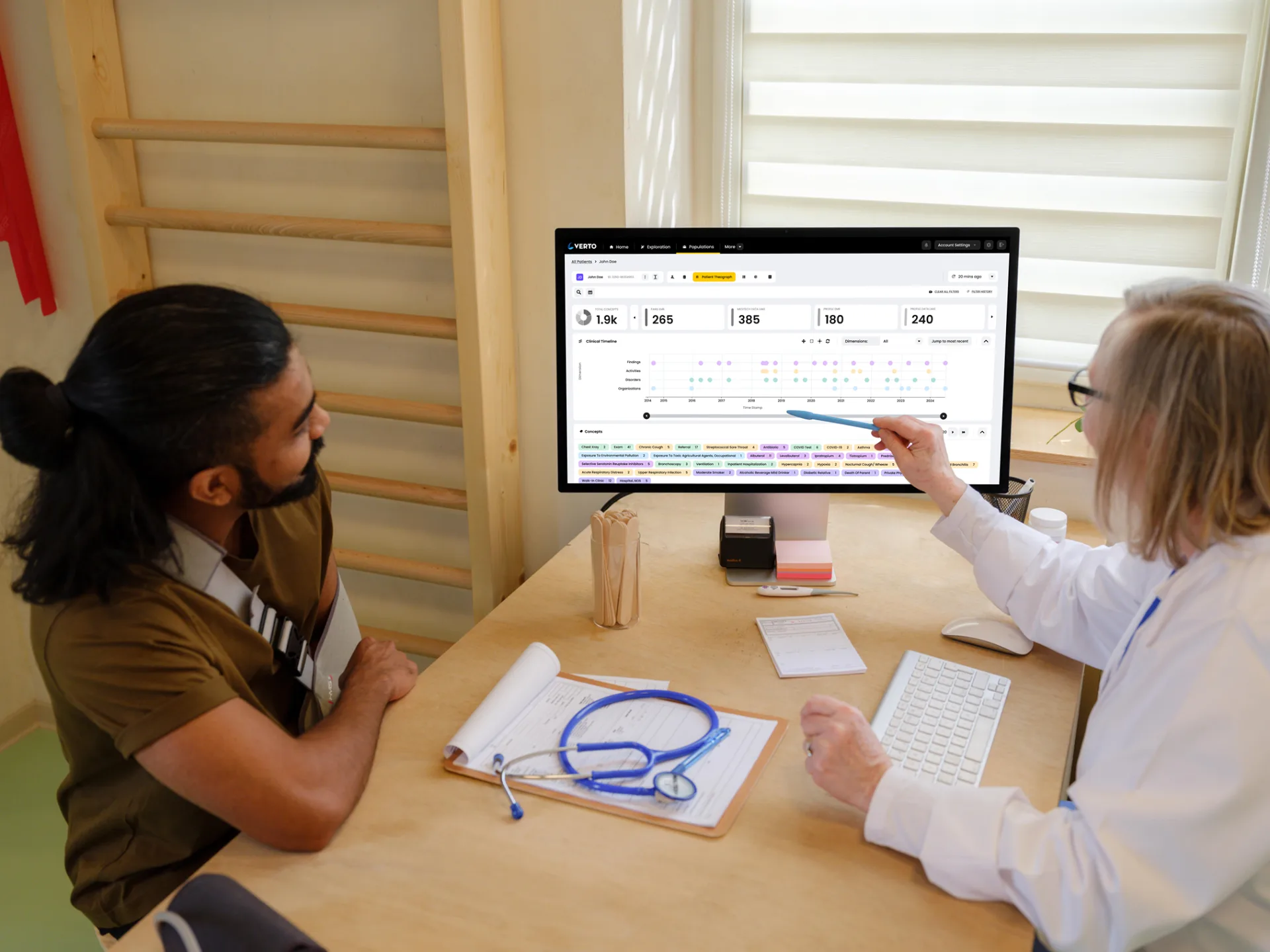
A reviewer or a clinician reads each finding and confirms it or discards it. Verto doesn't make the determination.
Your reviewer isn't hunting through a chart for where a clinician wrote something. They read a sentence the engine already found and decide whether it supports the finding.
What the engine is responsible for, and what you are
- The engine
- Reads every document and finds the concepts in the prose. Each one stays tied to the sentence it came from, and only those get reported.
- Your reviewer
- Opens the finding, reads the sentence, and decides whether it supports the code.
- The record
- Stays where it is, in the systems that already hold it. The finding points back at the source rather than replacing it.
Why the tracing has to hold
Reading the whole record turns up findings a coded feed never had. Your reviewer can only defend one of those findings if it still carries the sentence it came from.
About 80%
of what a clinician records about a patient is written in notes, not entered as a code
22%
more risk factors captured once unstructured records are read alongside coded data
20 minutes to 2 seconds
to find a documented condition in a patient's chart, as reported by an informaticist and registered nurse at a rural medical centre
Clinical evidence and source verification
- 01What is clinical data provenance in care gap detection?
- Provenance connects a finding to the record that supports it. Verto presents the source document, date and supporting phrase so a reviewer can inspect the evidence in context.
- 02Can a reviewer verify findings from scanned clinical documents?
- Verto reads scanned documents alongside structured records and links findings to source text. Review the patient identity, event and dates as well as the highlighted phrase; a matching term alone is not evidence that care occurred.
- 03Does an AI finding establish a diagnosis or coding decision?
- No. A finding supports review; it is not a clinical diagnosis or an automatic coding determination. The responsible professional evaluates the documentation and applies the relevant clinical or coding requirements.
- 04What happens when a finding has no supporting source?
- Verto does not report a finding it cannot trace to supporting text. Missing evidence still needs attention: the absence of a reported finding should not be treated as proof that no care gap exists.
Where to next
Next step
Run a record through our summary tool
Pick a record, click any finding, and it opens with the sentence it came from.
A first conversation about your patients, not a demo.