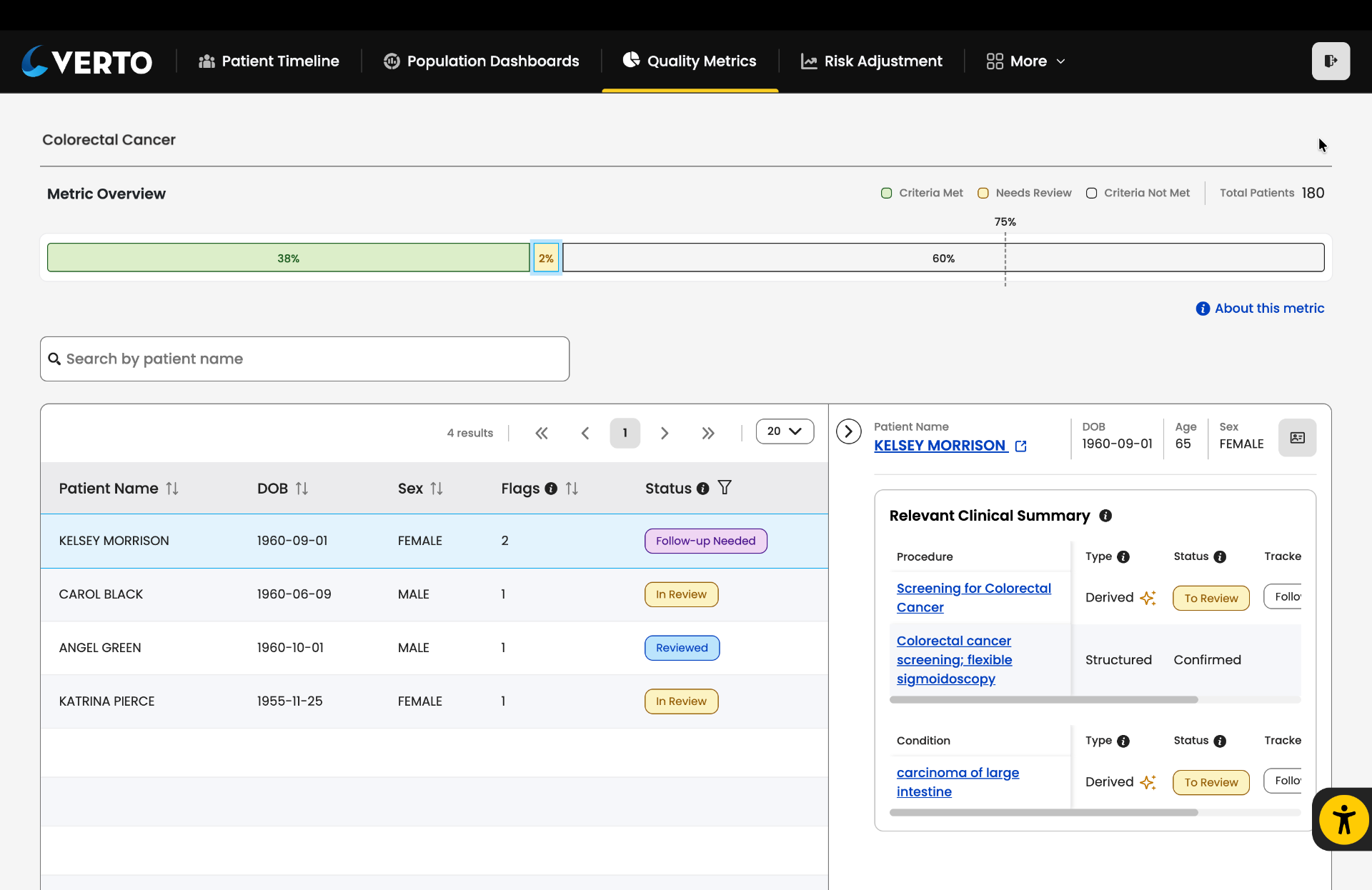


Assemble the panel
Start with what you have: your own records, claims, health information exchange feeds, and the material that arrives as faxes and scans. One view per member, each fact still tied to the document it came from.
Deadline: January 1, 2027
Work-requirement screening asks your members to prove something their records mostly already show. Verto reads those records, finds the qualifying evidence, and points at the sentence it came from.

In use at
Regional medical centers and risk-bearing groups.


CMS-2454-IFC · January 1, 2027
Under the rule published as CMS-2454-IFC, states begin screening Medicaid members against work requirements on January 1, 2027. Members keep their coverage when someone can show they qualify. Verto finds that evidence in the chart.
Most exemptions are clinical conditions. Clinicians record them during care, describing what they found. They are written in prose, in whichever system happened to receive that visit.
Then the screening runs against coded, structured fields. A condition documented in a discharge summary but never coded won't show up in the screen.
People who are eligible will lose coverage because the proof of it was never in a field.
How Verto is used here
Assemble the records, screen them against the exemption criteria, cite the sentence, route the list.
Start with what you have: your own records, claims, health information exchange feeds, and the material that arrives as faxes and scans. One view per member, each fact still tied to the document it came from.
Screen every member against the exemption criteria, and rank by exposure: who appears to qualify and has nothing coded to show it, who is closest to losing coverage, who needs a human to look.
Each finding comes with the document it came from and the sentence that supports it. A reviewer reads what the clinician wrote and decides.
Appears to qualify · nothing coded
Qualifying condition, documented in prose
Behavioral health intake note · scanned to the chart
Currently enrolled in a structured outpatient treatment program, attending three sessions weekly since March, engaged and stable.
Sample record.
Route the list. Documentation that needs a clinician goes to a clinician. Members who need to act get contacted the way they prefer.
Every source ends up in one view per member.
Measured in Verto's own risk work.
22%
more risk factors captured once unstructured records are read alongside coded data
19%
of members in Verto's risk adjustment work had a documented condition that coded data alone had missed
About 80%
of what a clinician records about a patient is written in notes, not entered as a code
A missed diagnosis costs an organization revenue. A missed exemption costs a person their coverage.

Next step
Send a sample of your panel. You get back how many members appear to qualify for an exemption with nothing coded to show it, each one linked to the text that supports it.
No account, no call.