
To wrap up the series, we present the second episode of Verto Voices, an ongoing conversation where we profile some of Verto's innovative digital health leaders. For this installment, we interviewed Martin for a deep dive into AI and its application in healthcare.
The Path to AI in Healthcare
Q: We've been looking forward to this, Martin, so thanks for sitting with us today. Before we jump in, I want to take a minute to talk about what led you to where you are with Verto today. Your original educational and professional background is in finance, which is a good deal different from healthcare. Why the switch?
A: I think I had a very different way into the space, although many people you meet do have a weird path into AI. I did a commerce degree first. I got my CA/CPA, completed my CFA exams, and followed the traditional path of wanting to be an auditor at Deloitte.
Within a very short time, I found a lot of the audit work kind of monotonous, and I wanted to find new ways to automate it. I thought there were a lot of cool statistical ways to show that something was valid versus just brute-force testing. That was my very first experience with automation and applying slightly higher math than counting to achieve the same goal.
AI Explained: The 'Coles Notes' Version
Q: For folks who may not have much background knowledge of AI – can you give us the 'Coles Notes' version of your definition?
A: AI is not a neat term, and you're always hearing it synonymous with machine learning, deep learning, etc. My version of this is AI is like the wide umbrella term. Within that, you have the reason-based expert systems, knowledge graphs, and the actual learning domain of AI (machine learning). That's what's getting all the press right now.
AI's Role in Interoperability
A: I think one of the things that artificial intelligence can do right now is focus on interoperability, which is a massive problem in healthcare. It's one of the reasons why we struggle to get data to train our algorithms because there's so much that has to be done to get this data and transform it into something we can use.
Standards have their place in the health data world to standardize how that data looks, but it's not enough. So many legacy vendors don't want to change systems they deployed 20 years ago. We need to think of another way to transform data at the source and make it usable for things like analytics and decision-making.
How Verto Uses AI
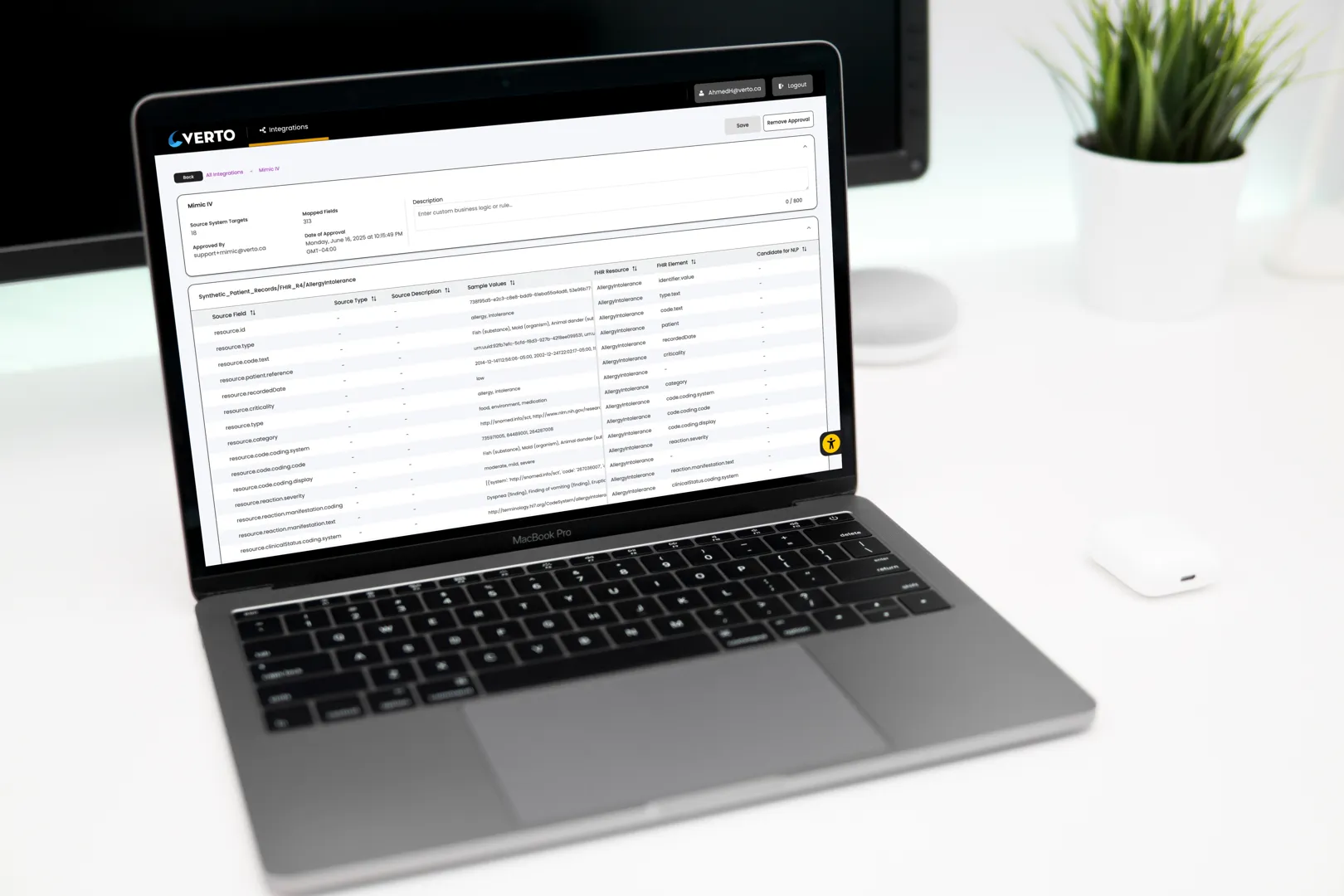
A: We do have a couple of patents that we've filed. One is specifically what I just spoke about – really honing in on the data ingestion because it comes in all these different formats. I think deploying that at scale and automating data mapping and schema matching will be a huge factor in the interoperability space.
The second is actually another patent. Everyone wants to solve the problem by being the "house of master data." Our second patent is very focused on virtualizing data so that we can point back to where it came from and maintain much of its provenance to make choices on it.
The Future: Multimodal AI in Healthcare
A: I can see a world in 10, maybe a little more than ten years, where these modalities come together and start to really drive multimodal decision-making. Not just based on some progress note but also based on the radiology report or the image itself.
Bringing these things together to tell the story of a patient is when things become really powerful.